
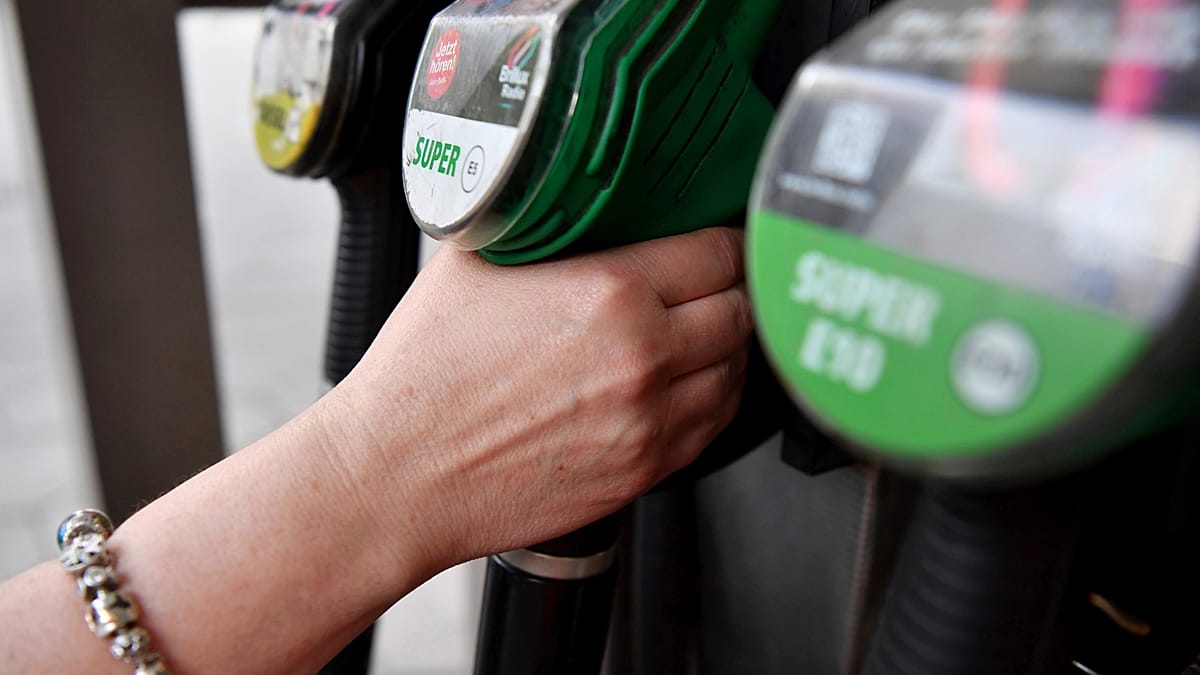
Filling up a car has never cost more in the European Union.
Euro-super 95 petrol reached a weighted EU average of €2.063 per litre on 14 September, the highest price in the European Commission’s series dating back to 2005.
The crisis began at the end of February, when the war with Iran broke out and disrupted energy flows through the Strait of Hormuz.
Brent crude cost about $72 per barrel before the war and was trading at more than $100 for next-month delivery on Monday.
Refineries added their own pressure.
Refining margins measure the gap between what refiners pay for crude and what they earn selling petrol and diesel.
ECB experts estimate that in the third week of September these margins added €0.17 to each litre of petrol in the euro area and €0.41 to each litre of diesel.
Yet, nearly half the money drivers hand over at the pump goes to governments as forms of taxes.
How the tax bill adds up
Petrol is taxed in two main stages. First comes excise duty, a fixed charge per litre that does not automatically rise with the price of oil. Some countries also impose carbon or other levies.
Then comes value added tax (VAT), charged on the fuel’s price after those duties and levies have been added. Drivers therefore pay VAT on excise duty: a tax on tax.
Across the EU, taxes averaged €0.976 per litre, accounting for 47.3% of the pump price. In seven member states, they exceeded €1.
Here are the ten countries with the highest tax bills per litre.
10. Latvia: €0.960 per litre
Latvia raised its excise duty on unleaded petrol in January from €532 to €555 per 1,000 litres, or €0.555 per litre.
A second charge pays for the country’s emergency oil stocks, the reserves every EU state must hold in case supplies are cut. It is set at €91.26 per tonne of oil products sold in Latvia, just under 7 cents per litre of petrol.
VAT at 21% adds €0.343.
In total, drivers in Latvia paid €0.96 in tax per litre, according to data filed last week.
9. Estonia: €0.963 per litre
Estonia charges an excise duty of €0.593 per litre, after raising fuel duties in May 2025. When prices surged this spring, Tallinn moved to drop a further rise planned for May 2026.
There is no other fuel levy. VAT at 24% adds €0.370.
That brings the Estonian tax bill to €0.963 on every litre, almost exactly half the €1.914 pump price.
8. Portugal: €0.978 per litre
Portugal’s main fuel tax, known as ISP, stood at €0.432 per litre in the week of 14 September. It includes the former road service contribution, which still accounts for 8.7 cents per litre of petrol.
The ISP is reduced by a temporary discount. It applies when prices rise more than 10 cents above early-March levels and hands drivers back the extra VAT the state collects.
A carbon levy adds €0.159 per litre in 2026, and VAT at 23% adds €0.387.
Added together, the three charges came to €0.978 per litre, according to the Commission’s latest bulletin.
7. Italy: €1.049 per litre
Italy charges an excise duty of €0.673 per litre. Petrol and diesel have carried the same rate since January, after the government cut petrol by 4.05 cents and raised diesel by the same amount.
Rome has cut the diesel rate several times since late July to cushion the price surge.
Petrol has had no cut.
VAT at 22% adds €0.376.
The Italian state collected €1.049 on every litre sold, just over half of the €2.084 pump price.
6. France: €1.052 per litre
France’s excise on petrol, formerly called TICPE, has been €0.690 per litre since 1 March.
VAT at 20% adds €0.362.
French drivers handed over €1.052 in tax for each litre.
5. Greece: €1.133 per litre
Greece charges an excise duty of €0.70 per litre on unleaded petrol.
Two small levies, both calculated as a percentage of the price, add about 1.5 cents: a customs-processing fee and a contribution to a special petroleum account.
VAT at 24% adds €0.418.
The total reached €1.133 per litre, or 52.5% of the pump price, the largest share in the top 10.
4. Germany: €1.179 per litre
Germany’s energy tax on petrol is a fixed 65.45 cents per litre. Berlin temporarily cut it by 14.04 cents from 1 May to 30 June because of the war, but the full rate is back.
A carbon price adds about €0.148 per litre. Since January, CO2 certificates for fossil fuels have been auctioned within a corridor of €55 to €65 per tonne.
VAT at 19%, one of the lowest rates in the bloc, adds €0.376.
Energy tax, carbon price and VAT combined came to €1.179 per litre, about half of what German drivers paid at the pump.
3. Finland: €1.193 per litre
Finland’s fuel duty of €0.722 per litre has three parts: a tax on the fuel’s energy content, a CO2 tax and a small security-of-supply fee.
In January, Helsinki lowered the carbon value used to calculate the CO2 tax from €62 to €56.8 per tonne.
VAT is where Finland stands out. Its 25.5% rate is the second-highest in the EU after Hungary’s 27%, and it adds €0.471 per litre.
Taken together, Finnish taxes came to €1.193 per litre, according to the latest Commission data.
2. Denmark: €1.230 per litre
Denmark has the most expensive petrol in the EU, at €2.564 a litre, but it is not the heaviest taxer.
Its fuel duties total 5.36 kroner per litre before VAT, about €0.717.
They are made up of an energy tax, a CO2 tax and a nitrogen oxides levy, with the CO2 part alone at 1.86 kroner.
VAT at 25% applies to a high pre-tax price of €1.334. It adds €0.513 per litre, the largest VAT amount in the EU.
That puts the Danish tax bill at €1.230 per litre, second only to the Netherlands.
1. The Netherlands: €1.270 per litre
No EU country takes more tax from a litre of petrol than the Netherlands.
The Dutch excise duty on petrol is €844.69 per 1,000 litres in 2026, the highest in the bloc. A levy that funds the national oil stockpile adds 0.8 cents.
VAT at 21% adds €0.422.
Every litre of petrol sold in the Netherlands carried €1.270 in tax last week, 52% of a €2.434 pump price.