
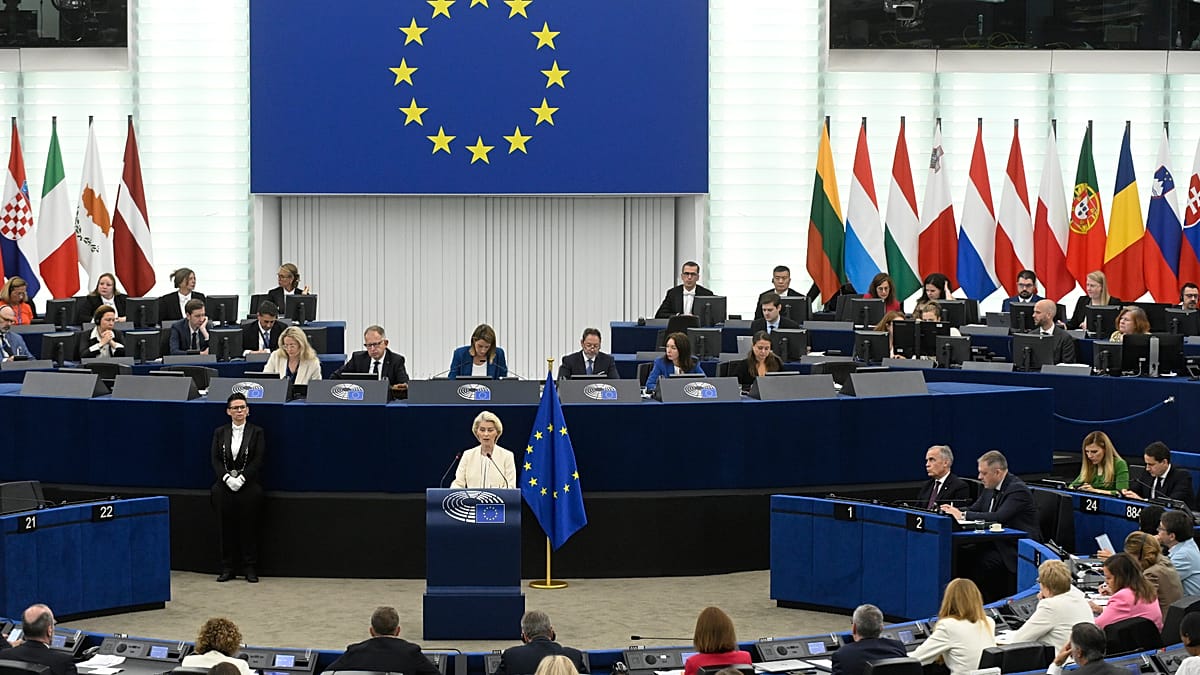
The European Commission President Ursula von der Leyen announced an EU Kids Act proposal restricting minors’ access to platforms such as Instagram, TikTok and YouTube, alongside new safety requirements for online services including video games and AI chatbots.
“We do not have to accept addictive features. We do not have to accept children being drawn into ever more extreme content. We do not have to accept that girls have their photos used for AI-generated sexualised images,” von der Leyen said.
“No personal account under the age of 15. No social media under the age of 13. That means only mini accounts from 13 to under 15, set up and supervised by parents, with limited features and time restrictions,” she told the European Parliament during her State of the Union address.
France, Greece, Austria, Denmark, Spain, Belgium, Italy, Germany, Poland and the Netherlands are all considering or advancing national legislation on social media bans, piling pressure on Brussels to present an EU-wide measure and avoid fragmentation.
In July, a group of experts convened by the EU executive released a series of recommendations on improving child safety online, many of which are reflected in the upcoming draft law.
The bill itself is due to be published on Thursday, but a leak obtained by Euronews already shows the details of the upcoming legislative proposal.
“Europe has the power to act. It is us who decide our rules, not big tech,” von der Leyen added.
Scope
The scope is broader than originally anticipated: the bill will also cover other online services deemed potentially harmful to minors, notably video games and AI companions – a move Spain and the Netherlands requested only last week.
The draft EU Kids Act covers social media, video-sharing platforms and online games, considered to pose “specific design risks for minors,” as well as AI-powered chatbots and companions, described as “virtual tools that can give mental health and personal development advice to minors.”
Services designed and operated for education or by public authorities, as well as AI systems intended for office or industrial use, are excluded from the scope.
Age limitations
The proposal combines safety-by-design requirements for all the digital services concerned with a minimum age requirement that applies only to social media platforms like TikTok and video-sharing platforms like YouTube.
The age restrictions apply to all minors under 15, following a graduated approach. Children under three are barred entirely from social media and other high-risk services.
From three to 13, children can access child-friendly services under adult supervision. Those aged 13 to 15 would get restricted access to social media and video-sharing platforms, with limited features and under parental control.
Safety-by-design rules remain in place for minors aged 15 to 18, even though teenagers in this age group could access the platforms without parental consent.
Companies like Meta and Google will have to verify users’ age when they open a new account, using an EU-wide age-verification app or other national solutions that check only whether the user is above a certain age.
Proportionate verification is required for existing accounts, based for instance on how long the user has subscribed to the service.
Safety by design
The draft EU Kids Act includes a list of dos and don’ts that tech companies will have to follow to ensure their digital services provide a safe, age-appropriate experience.
In particular, the bill bans design features such as infinite scrolling, artificial notifications and certain reward mechanisms.
Recommender systems, the algorithms that choose which content to display, should be designed to avoid so-called “rabbit holes” and other recommendations driven purely by engagement-based signals.
Risky settings should be disabled by default, while minors’ account content would have to be set to private, with unknown users unable to contact them. Reporting harmful content should be made easy.
The bill also envisages offering parents age-appropriate parental control tools.
“These rules and principles will be complemented by tailored commitments for online games, AI chatbots and companions, offering a co-regulatory approach based on industry-led self-regulation,” the document reads.
Enforcement
Brussels has often been criticised for being too soft in enforcing its digital rules, as the online environment tends to move too fast for public authorities to keep up.
As a result, the Commission is proposing to shift the burden onto tech companies to prove they are complying with child-safety rules.
Online services already subject to the Digital Services Act’s stricter regime, because they are deemed to pose a systemic risk to society, will have to seek authorisation from the Commission before rolling out any new features that could affect children.
Tech companies would be charged a supervisory fee to finance enforcement.