
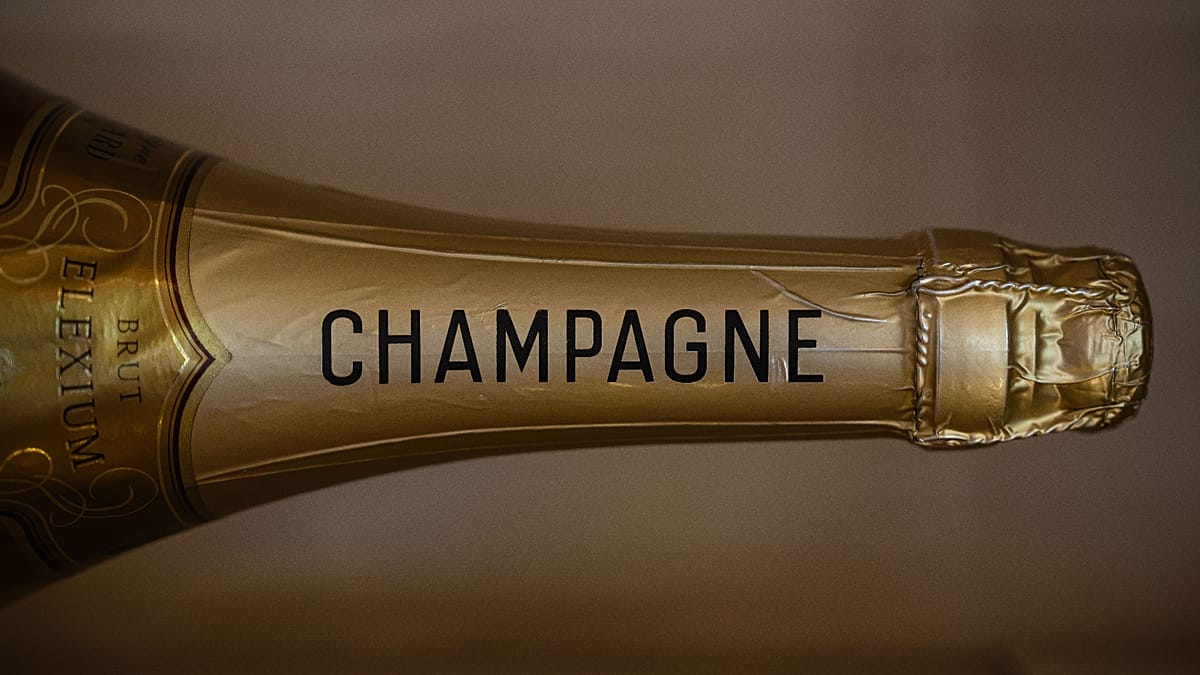
France’s Champagne region is facing an extraordinary harvest collapse. Yet consumers should not expect the number of bottles reaching shops to halve — at least not yet.
The reason is that this year’s harvest does not determine how many bottles can be sold immediately. Champagne takes several years to make, and producers hold substantial stocks and reserve wines from earlier harvests to help maintain supply when a crop is poor.
And across France, wine production is expected to reflect a very poor harvest this year. According to preliminary estimates from Agreste, the French Agriculture Ministry’s statistics office, overall wine production is to fall to 3.39 billion litres in 2026.
That would be 6% less than in 2025 and 28% below the 4.72 billion litres produced in 2023.
If confirmed, it would also be France’s smallest wine crop since 1957, when output stood at 3.25 billion litres, according to the International Organisation of Vine and Wine.
The decline partly reflects a 2.5% reduction in the area of French vineyards in production. But drought and repeated heatwaves have had the greater effect by reducing the amount of wine produced from each hectare.
“Evidence strongly suggests that heat and drought, through lower yields per hectare, are the dominant explanation for this year’s exceptionally low harvest,” Jean-Marie Cardebat, Professor at Bordeaux University and affiliated to INSEEC Business School, told Euronews Business.
The regional figures support this. Some of the steepest falls are in areas where relatively few vineyards have been removed.
Bordeaux and Languedoc-Roussillon, where large areas of vines have been uprooted, are expected to produce 10% and 5% more wine respectively than in 2025, although both remain below their recent averages.
Why has Champagne been hit so badly?
Wine production from this year’s harvest in the Champagne region is forecast to fall by 48%, from 2.57 million hectolitres in 2025 to 1.34 million this year.
For wine carrying the Champagne protected designation, the fall is slightly steeper. Output is expected to drop by 49% to 1.24 million hectolitres, 47% below the five-year average.
However, these figures refer to wine made from grapes harvested this year. Not the number of bottles of Champagne to be sold.
After Champagne, the worst affected regions are Jura, where production is forecast to fall by 36%, and Bourgogne-Beaujolais, where it is expected to decline by 33%. Losses for Burgundy Pinot Noir exceed 50%, according to Agreste.
In Champagne, harvesting began in mid-August and the grapes reached exceptional ripeness. But frost in the Aisne, hail and drought since March severely reduced the crop. The average weight of grape bunches fell to its lowest level in 20 years.
Will fewer bottles of Champagne be sold?
The crop damage is severe, particularly for individual growers. But a 49% fall in wine produced from this year’s grapes does not mean the supply of finished Champagne will immediately fall by the same amount.
Before the full scale of the damage was clear, the industry had set the amount of the 2026 harvest that could be sold at 8,800 kilograms of grapes per hectare. That was only around 2% below the 9,000 kg/ha limit set in 2025 and reflected weaker demand and the need to manage stocks.
The actual harvest is now expected to average no more than around 7,000 kg/ha, according to the Syndicat Général des Vignerons de la Champagne. That would be the lowest level since the 1980s.
Growers who fail to reach the permitted level cannot make up the missing grapes. Champagne houses, however, can soften the impact by drawing on wines held in reserve.
“Champagne has lost roughly half of a normal harvest, but this will not translate into an immediate 50% fall in sales because producers can draw on extensive stocks and reserve wines,” Professor Cardebat said.
He called the production loss “extremely significant”, adding that the lost production was “equivalent to approximately 140 million 75-centilitre bottles”.
This represents about €2.7bn in potential commercial value, according to the professor, based on the average turnover generated per bottle shipped in 2025.
However, he stressed that this was not an estimate of immediate revenue losses because producers can draw on substantial stocks and reserve wines.
Professor Cardebat described the situation as “a major production and productivity shock”, adding that the longer-term risk would arise if very small harvests became recurrent.
“Then stocks would decline, costs would rise, and Champagne could eventually become less able to supply all its markets,” Professor Cardebat told Euronews Business.
A smaller harvest is not entirely bad news – yet
Overall, the smaller harvest is not expected to have an immediate significant impact on wine producers’ revenue.
According to Professor Cardebat, the greater economic concern is the accumulation of poor harvests. “This will be the third consecutive very small French harvest,” he said, adding that many producers were already financially fragile because demand had weakened while the costs of energy, labour, machinery and financing had risen.
Lower yields also mean that producers must spread many of their costs across fewer bottles, pushing up the cost of each one and squeezing profits. Even if stocks delay the impact on revenue, another poor harvest could further weaken cash flow and producers’ ability to invest.
Producers also risk losing shelf space if they cannot supply retailers consistently. If Champagne shortages persisted, competitors such as Prosecco and Crémant could gain ground among shops and consumers.
However, France has also been struggling with excess supplies of some wines, particularly red wine, as consumption declines. A temporarily smaller harvest can help reduce stocks and bring supply closer to demand without permanently removing more vineyards.
According to Professor Cardebat, this creates a paradox: “Economically, lower productivity is bad for producers, but lower aggregate supply can help rebalance a market suffering from excess production”.
He also added that the regions suffering the largest shock from bad weather conditions this year are not those facing the greatest structural financial risk. Champagne benefits from a powerful global brand, relatively high margins and its reserve system.
According to Professor Cardebat, the bigger structural risks were in Bordeaux, the South-West and parts of Languedoc-Roussillon, where producers have faced weak demand, low prices and vineyard removals. Those relying heavily on red wine are generally more exposed than producers of white or sparkling wine.
The Champagne harvest is therefore the most dramatic part of France’s 2026 wine story, but not necessarily its greatest financial crisis. Its reserves should keep bottles moving for now. The test will come if harvests of this size stop being exceptional.