
Published on
As the return of humans to the Moon and their long-term stay there come ever closer thanks to the Artemis programme over the next few years,which will also feature the first lunar habitat module developed in Italy, the scientific community is already working on the prospect of colonising Mars.
Researchers at the Hong Kong University of Science and Technology (HKUST) have developed an innovative formula for 3D printing housing structures on the Red Planet, combining three elements: gelatine, yeast and regolith.
What is Martian regolith
The study, led by civil engineer Jishen Qiu, was published in the journal Chem Circularity and reported by Interesting Engineering. (source in Italian)
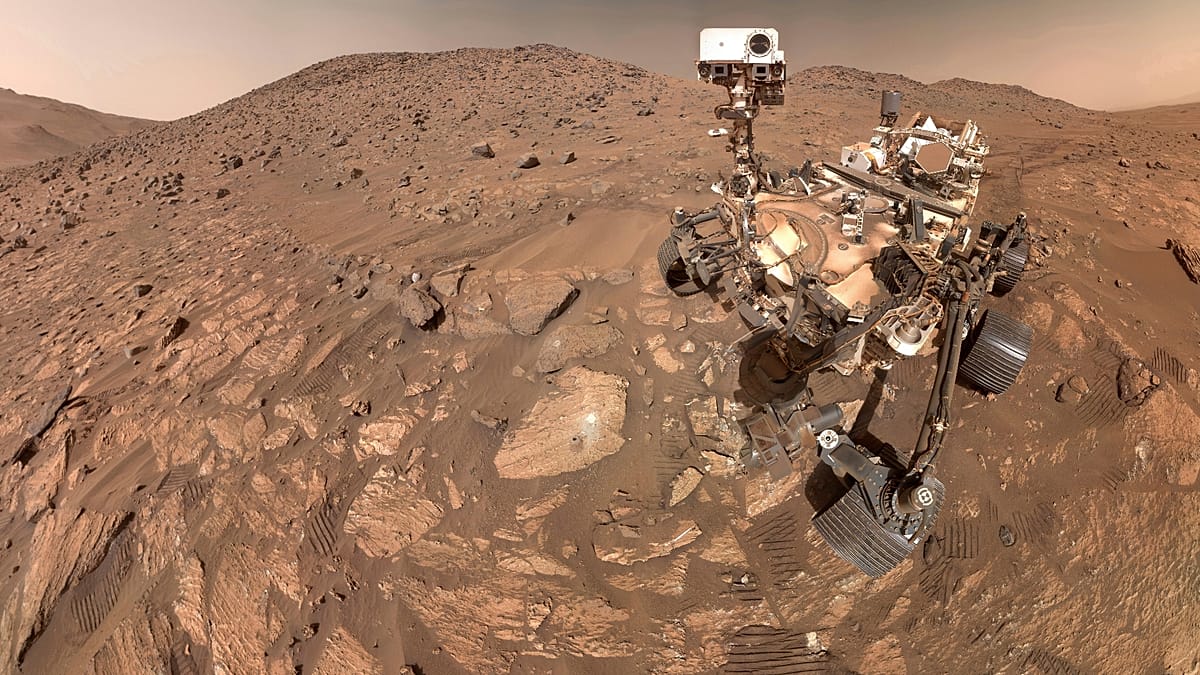
The most striking innovation is undoubtedly Martian regolith, the layer of rocky material, made up of fine dust, sand, pebbles and rock fragments, that covers the entire surface of the planet.
The compound devised by the Hong Kong researchers would use it as a structural base to give volume and mass to the construction.
To this “local” raw material are added a very special yeast, engineered with adhesive proteins (modelled on the natural glue mussels use to cling to rocks) and gelatine, which acts as a binder and nutrient for the yeast.
In the HKUST experiments the researchers also tried to harness Mars’ frozen climate as a natural freeze-dryer to save energy and avoid melting the minerals.
During processing in the 3D printer they therefore used low temperatures and reduced atmospheric pressure to encourage the sublimation of ice into vapour, generating a solid, lightweight foam.
Tests in simulated environments ultimately confirmed that the new compound resists compression at a level comparable to lightweight concrete, making it ideal for building multi-storey, fully recyclable structures.
However, several challenges remain regarding the sustainability of this Martian architecture, including the ability of micro-organisms to survive in the planet’s environment and its dependence on resources sent from Earth.
From biomaterials for circular architecture to NASA projects
The use of yeast in 3D manufacturing technologies has a precedent in the laboratories of the Chalmers University of Technology in Sweden, as documented by MaterialDistrict (source in Italian).
The Swedish team has created a hydrogel made from yeast and cellulose to produce biodegradable architectural components. This approach also shows how adding value to food-industry waste can foster circular architecture both on Earth and in space missions.
In parallel with academic research, the aerospace sector is developing industrial-scale 3D printing for space habitats. As reported by Rinnovabili.it (source in Italian), NASA has allocated around 57.2 million dollars in recent years to the Olympus Project, dedicated to building permanent infrastructure on the Moon and Mars.
One of the practical developments of these technologies is Mars Dune Alpha, a 150-square-metre structure produced by 3D printing in Houston. NASA has used this habitat module in the Chapea analogue missions to test human life on Mars, laying the foundations for future human colonisation of space.